
PRP Therapy for Tendon Injuries: Benefits, Recovery, and What to Expect
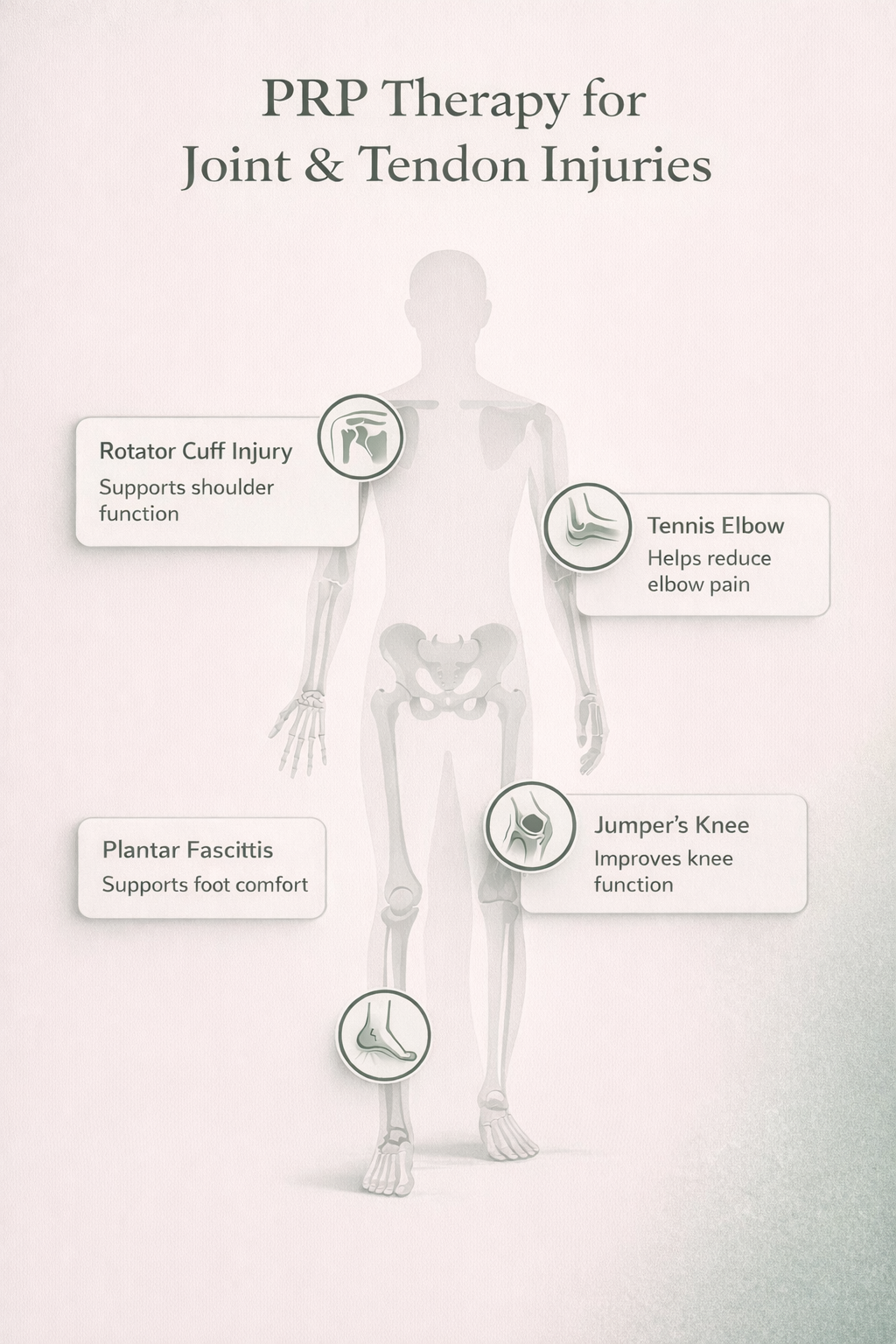
Persistent tendon pain can be frustrating, especially when rest, physical therapy, and anti-inflammatory treatments have not provided lasting relief. Conditions like tennis elbow, Achilles tendinopathy, and rotator cuff irritation often heal slowly, which is one reason some patients start looking into regenerative treatment options.
PRP therapy for tendon injuries is a non-surgical treatment that uses a concentrated portion of your own blood, which is then injected into the injured area. For some patients, this may help support healing, reduce pain, and improve function over time.
This guide explains what PRP is, how it works, which tendon injuries it may help treat, what recovery can look like, and who may be a good candidate.
What to Know
PRP therapy uses your own blood platelets to deliver concentrated growth factors to an injured tendon.
It may help some chronic tendon injuries, especially when symptoms continue despite rest, rehabilitation, or medication.
PRP is not an instant fix. Improvement often develops gradually over weeks to months.
Results vary based on the condition, severity of tissue damage, and how recovery is managed after treatment.
A proper evaluation still matters, because not all tendon pain is treated the same way.
What Is PRP Therapy for Tendon Injuries?
PRP stands for platelet-rich plasma. It is made by taking a small sample of your blood, processing it in a centrifuge, and separating out a platelet-rich portion that can then be injected into the injured tissue. Platelets are best known for helping blood clot, but they also contain growth factors involved in tissue repair and healing signals.
PRP is often discussed for tendon injuries because tendons can heal slowly. Compared with many other tissues, they have a more limited blood supply, which can make recovery from chronic overuse injuries more difficult. Rather than simply masking pain for a short time, PRP is intended to support the body’s repair response.
In practice, PRP is usually considered when tendon symptoms continue despite conservative care such as activity modification, physical therapy, bracing, or other non-surgical treatments. It is more often discussed for chronic tendon problems than as a first-line treatment for every new injury.
Why is PRP used for tendon injuries?
PRP may be considered for tendon injuries because:
tendons often have a limited blood supply
chronic overuse injuries can heal slowly
some cases involve ongoing tissue degeneration rather than only short-term inflammation
selected patients may benefit from a treatment that aims to support tissue repair
PRP does not work the same way for every patient or every diagnosis. Its benefit can vary depending on the tendon involved, how long symptoms have been present, the extent of tissue damage, the injection technique used, and the rehabilitation plan after treatment.
What Tendon Injuries Can PRP Help Treat?
PRP is most often discussed for chronic tendon injuries that have not improved enough with rest, rehabilitation, activity changes, or other conservative treatment. It is not appropriate for every tendon problem, but it may be considered in selected cases where healing has stalled and symptoms continue to affect daily activity, exercise, or work.
In general, PRP is used more often for tendinopathy and some partial tendon injuries than for complete ruptures. Common conditions where PRP may be discussed include the following:
1. PRP for tennis elbow
Tennis elbow, also called lateral epicondylitis, affects the tendons on the outside of the elbow. It is commonly linked with repetitive gripping, lifting, typing, or wrist movement.
Common symptoms may include:
pain on the outside of the elbow
discomfort with gripping or lifting
pain with typing or wrist movement
PRP may be considered when symptoms become chronic and standard treatments such as rest, bracing, rehabilitation, and activity modification have not provided enough relief.
2. PRP for Achilles tendinopathy
Achilles tendinopathy affects the large tendon at the back of the ankle and is common in runners, active adults, and people whose activity levels increase quickly.
Common symptoms may include:
stiffness in the back of the ankle
tenderness along the tendon
pain during walking, running, or climbing stairs
Because the Achilles tendon handles high loads and may heal slowly, PRP may be considered in selected cases of persistent Achilles tendon pain.
3. PRP for patellar tendinopathy
Patellar tendinopathy, sometimes called jumper’s knee, affects the tendon that connects the kneecap to the shinbone. It is often associated with repetitive jumping, sprinting, or loading of the knee.
Common symptoms may include:
pain at the front of the knee
discomfort during jumping or running
pain that worsens with sports or exercise
When symptoms become chronic, PRP may be discussed if load management and physical therapy have not provided enough improvement.
4. PRP for rotator cuff tendinopathy or partial tears
The rotator cuff includes tendons that help stabilize and move the shoulder. Overuse, repetitive overhead activity, age-related tendon changes, or partial tearing can lead to ongoing shoulder pain and weakness.
Common symptoms may include:
shoulder pain with lifting or reaching
weakness in the shoulder
limited range of motion
discomfort with overhead activity
PRP may be considered for selected rotator cuff tendon problems, especially when there is persistent pain without a full-thickness tear that clearly requires surgery.
5. PRP for plantar fasciitis
Plantar fasciitis is technically not a tendon injury, but it is often discussed alongside chronic soft tissue overuse conditions because it can behave in a similar way. It causes pain along the bottom of the heel and is sometimes included in PRP discussions for stubborn foot pain.
Common symptoms may include:
sharp heel pain with the first steps in the morning
pain after long periods of standing
discomfort that improves, then returns with activity
In patients with persistent symptoms that do not improve with stretching, footwear changes, orthotics, or other conservative care, PRP may sometimes be considered as an injection-based treatment option.
6. PRP for other chronic soft tissue injuries
In selected cases, PRP may also be discussed for other stubborn overuse injuries or chronic soft tissue problems.
Examples may include:
gluteal tendinopathy
hamstring-related soft tissue irritation
other overuse-related injuries that have not improved with standard care
Whether PRP is appropriate depends on the diagnosis, symptom duration, imaging findings when needed, and overall treatment goals.
Support Healing at the Source
What Happens During PRP Treatment and Recovery?
PRP treatment is usually performed in an outpatient setting and does not require surgery. While protocols vary by clinic and injury type, the process usually includes a few standard steps.
What happens during the procedure?
Blood draw
A clinician draws a small sample of your blood, similar to a routine lab draw.Centrifuge processing
The blood sample is placed in a centrifuge, which spins the sample to separate and concentrate the platelet-rich plasma.Injection into the treatment area
The PRP is injected into the injured tendon or nearby tissue. In many cases, image guidance such as ultrasound is used to improve accuracy.Post-procedure instructions
After the injection, you are typically given guidance on activity modification, pain management, and when to restart rehabilitation or exercise.
Some patients have one PRP injection, while others may need more than one treatment depending on the tendon involved, how long symptoms have been present, and how they respond after the first session.
What is recovery like after PRP?
Recovery after PRP is usually gradual. Unlike an injection mainly intended to suppress pain quickly, PRP is meant to support the body’s healing response over time. That means improvement often develops over weeks to months rather than immediately.
After the injection, some patients notice short-term soreness or stiffness in the treated area. Common short-term effects can include:
soreness at the injection site
temporary swelling or stiffness
mild discomfort with movement for a few days
Many patients are advised to avoid high-impact exercise, heavy loading, or aggressive stretching right away. Depending on the injury, a clinician may recommend a short rest period followed by a progressive rehabilitation plan.
Return to activity should usually be gradual. In many cases, recovery includes:
early activity modification
structured rehabilitation or physical therapy
progressive loading as symptoms improve
Trying to return to sports or heavy activity too quickly may place too much stress on healing tissue, so a guided recovery plan is often important.
Request an Appointment
If chronic tendon pain is not improving with rest, physical therapy, or other conservative treatment, an evaluation can help determine whether PRP is the right next step. At SageMED Bellevue, we help patients explore regenerative treatment options based on their diagnosis, symptoms, and recovery goals.
Request an appointment or call 425-679-6056 to find out whether PRP therapy may be appropriate for your tendon injury and recovery goals.
Final Thoughts
PRP therapy for tendon injuries may be a useful option for selected patients dealing with chronic tendon pain that has not improved with conservative care. It is most often considered as part of a broader treatment plan that includes accurate diagnosis, activity modification, and progressive rehabilitation.
If you are dealing with persistent tendon pain, the next step is not just choosing a treatment. It is getting the right evaluation to understand what is causing the problem and whether PRP fits your recovery goals.
References
American Academy of Orthopaedic Surgeons. Platelet-Rich Plasma (PRP).
https://orthoinfo.aaos.org/en/treatment/platelet-rich-plasma-prp/
Mayo Clinic. Platelet-rich plasma (PRP) therapy.
https://www.mayoclinic.org/tests-procedures/prp-therapy/about/pac-20384734
Cleveland Clinic. Platelet-Rich Plasma (PRP) Injections.
https://my.clevelandclinic.org/health/treatments/platelet-rich-plasma-prp-injection
Fitzpatrick J, Bulsara M, Zheng MH. The Effectiveness of Platelet-Rich Plasma in the Treatment of Tendinopathy: A Meta-analysis of Randomized Controlled Clinical Trials. Am J Sports Med. 2017 Jan;45(1):226-233. doi: 10.1177/0363546516643716. Epub 2016 Jul 21. PMID: 27268111.
read this next